

Why India Lost to South Africa in T20 World Cup 2026 – Full Match Analysis & Super 8 Qualification Scenario
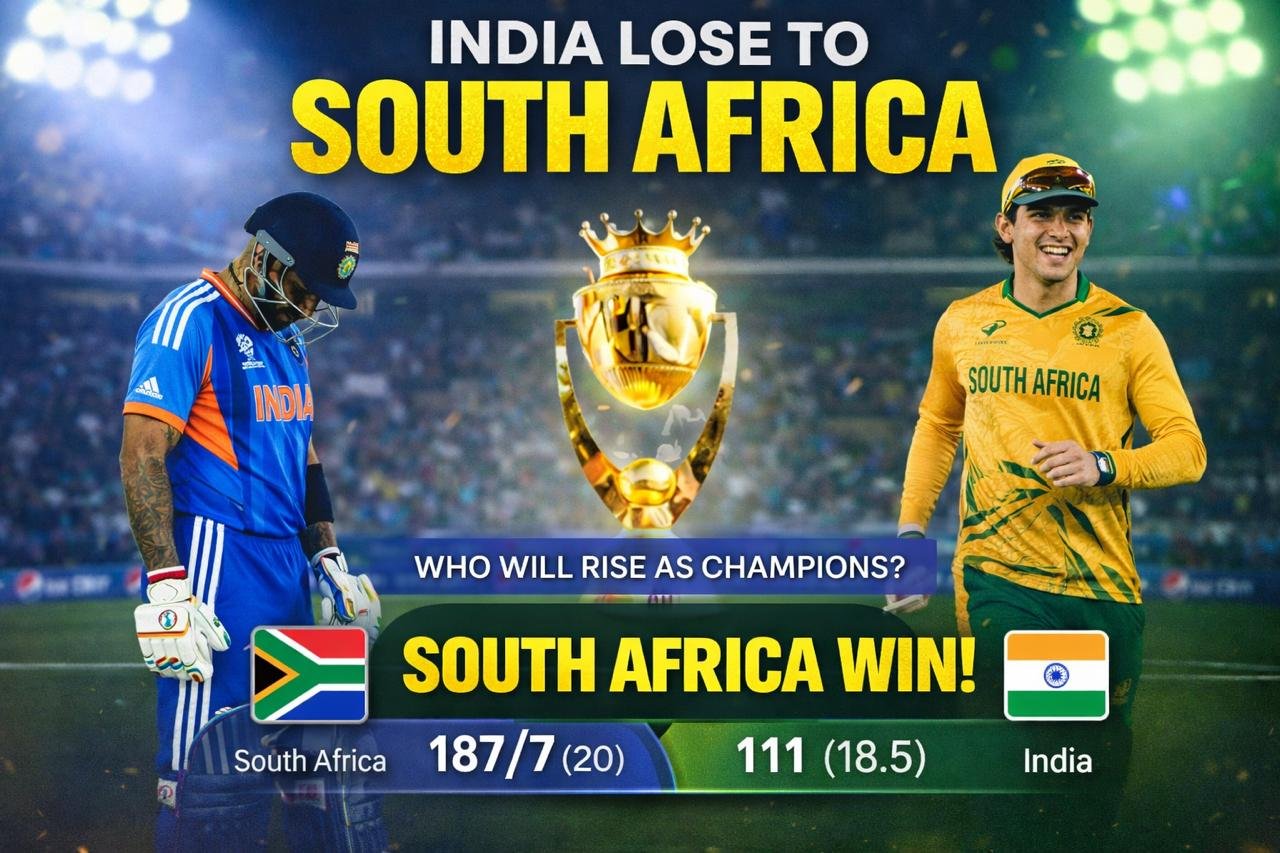
The India Cricket Team suffered a heavy defeat of 76 runs against South Africa in a crucial T20 World Cup clash — and this loss was not just about one bad day. It exposed some deep concerns in team selection, batting approach, and game awareness.
Let’s break it down in simple words.
Wrong Team Selection – Unnecessary Experiment
The Fundamental Flaw: Over-Experimentation
-
Breaking the Rhythm: In a high-stakes environment like the T20 World Cup, a "settled XI" is the greatest asset. The article argues that India abandoned a winning formula in favor of theoretical advantages.
-
The "Paper vs. Pitch" Reality: Strategic decisions made in the dugout often fail to translate to the field. Relying on data-driven "match-ups" rather than player form and team chemistry proved to be a fatal miscalculation.
The Washington Sundar Case Study
The inclusion of Sundar served as the primary example of this tactical failure:

-
The "Match-up" Trap: He was brought in specifically to counter left-handed batters, a move that prioritized a specific niche over overall team balance.
-
Double Failure: The gamble failed on both fronts—he was unable to stifle the run flow with his off-spin and failed to provide the necessary lower-order cushion with the bat.
-
The Domino Effect: His inclusion didn't just affect one slot; it disrupted the established roles of the other ten players, leading to a visible loss of cohesion under pressure.
The Knockout Lesson
-
Pressure Amplifies Mistakes: While experiments might pass in a bilateral series, the knockout-style pressure of the World Cup leaves zero margin for error.
-
The Verdict: India’s defeat wasn't just a failure of execution, but a failure of selection logic.
Inability to Play Spin – A Known Weakness
The False Sense of Security
-
Masked by Individual Brilliance: The article argues that India’s struggles against spin were evident even in earlier wins against USA, Netherlands, Pakistan, and Namibia. However, "individual brilliance"—like Shivam Dube’s 66 vs. Netherlands or Ishan Kishan’s 77 vs. Pakistan—acted as a veil, hiding systemic issues from the management’s eyes.
-
The "Minor Side" Delusion: Winning against smaller teams created a dangerous comfort zone. Against South Africa, a disciplined and tactically superior unit, the "Individual Hero" strategy finally reached its expiration date.
The Anatomy of the Collapse
When South Africa’s spinners (led by Keshav Maharaj) applied the squeeze in Ahmedabad, the Indian batting unit suffered a total system failure:
-
Uncertainty & Stagnation: Batters looked hesitant, failing to read the length or the turn, which led to a complete halt in strike rotation.
-
The "Dot Ball" Poison: As dot balls mounted, the pressure became unbearable. This forced batters into high-risk shots, effectively gifting wickets to the opposition.
-
Power-Hitting vs. Smart Cricket: The article critiques the team's over-reliance on raw power. On the sluggish Ahmedabad surface, "Smart Cricket"—finding gaps and running hard—was required, but India lacked the tactical flexibility to adapt.
The Reality Check
-
A Professional Standard: International cricket at the Super 8 level demands more than just muscle. If India cannot rotate strike against quality spin, they cannot survive the business end of the tournament.
Poor Form of Abhishek & Tilak – Top Order Collapse
The Top-Order Liability
-
Persistence with Poor Form: The article highlights a growing frustration with Abhishek Sharma and Tilak Varma. Despite a string of low scores—including Abhishek's three ducks earlier in the tournament—the management's refusal to acknowledge these "warning signs" has left the team vulnerable.
-
The Blueprint for Defeat: South Africa didn’t just win; they executed a pre-planned ambush. By attacking early and drying up the boundaries, they forced the out-of-form duo into errors.
South Africa’s "Piece of Cake" Victory
The Proteas' bowling attack, led by Marco Jansen, exploited the technical and mental gaps in the Indian top order:
-
Early Exploitation: By removing the openers and Tilak Varma within the first few overs, South Africa effectively ended the chase before it began.
-
The "Easy" Target: The article argues that India's batters made the opposition look better than they were. The lack of intent and failure to adapt to the conditions in Ahmedabad essentially "gifted" the match to the Proteas.
The Strategic Blind Spot
-
Ignoring the Obvious: While social media and analysts were calling for changes (like the inclusion of Sanju Samson), the management stuck to their guns. This section suggests that "loyalty" to struggling players is becoming a "liability" for the national side.
Captaincy Decisions – Tactical Errors
The Rigidity of Command
-
The "Template" Over Tactics: The article critiques Suryakumar Yadav for a perceived lack of on-field intuition. By sticking to a rigid batting order even as wickets tumbled, the leadership failed to "arrest the slide," allowing South Africa to dictate the tempo for the entire 40 overs.
-
Lack of Flexibility: In a chase of 188, when the top order collapsed to 20/3, there was no tactical reshuffle (like promoting a pinch-hitter or a stabilizer). This "wait and watch" approach proved fatal in a format that demands proactive responses.
The Psychological Toll
-
Late Reaction to Pressure: The article argues that the leadership only began to "react" once the game was already slipping away. In a World Cup knockout scenario, being reactive rather than proactive is a recipe for disaster.
-
The Confidence Crisis: This isn't just one loss; it’s a massive dent in the team’s morale. Moving from a dominant group stage to a 76-run thrashing creates a psychological baggage that India must shed before their next outings.
The Road Ahead: High-Stakes Hurdles
The defeat has turned the remaining Super 8 fixtures into virtual knockouts:
-
The Zimbabwe Threat: An unbeaten Zimbabwe side, coming off giant-killing wins against Australia and Sri Lanka, will not be intimidated by a wounded India in Chennai.
-
The West Indies Challenge: With their explosive power-hitting and resurgent form, the Windies in Kolkata represent the ultimate test of India's "damaged" tactical confidence.
Semi-Final Qualification: Is It Still Possible?
The Current Standing
-
Fate in Their Own Hands: Despite the recent 76-run setback against South Africa, India’s path to the semi-finals remains open. Their destiny isn't tied to other results yet; it’s tied to their own performance.
-
The NRR Myth: While the -3.800 Net Run Rate looks daunting, it isn't the primary hurdle. Success in the upcoming must-win matches against Zimbabwe and the West Indies will naturally rectify the numbers.
The Core Crisis: Team Combination
The article identifies a "persistence with failure" as the greatest threat. The current strategy is facing three critical "leaks":
-
The Left-Hander Trap: A top order heavy with left-handers (Abhishek Sharma, Ishan Kishan, Tilak Varma) has become a predictable target for opposition off-spinners.
-
Form vs. Reputation: Relying on underperforming assets—specifically Abhishek Sharma’s struggle for runs and Tilak Varma’s strike rate—is creating a "dead zone" in the powerplay.
-
Tactical Rigidity: Repeating the same selection mistakes allows opponents to exploit well-documented weaknesses, effectively handing them a blueprint to defeat the hosts.
Bottom Line: India is at a tipping point. Survival in this World Cup requires a "rethink over repeat" strategy before the weaknesses become permanent exit doors.
What India Must Do Now
The Strategic Wake-Up Call
1. The Opening Firepower: Sanju & Abhishek
If Tilak Varma continues to struggle, the immediate move is bringing in Sanju Samson. In this scenario, Sanju should open the innings with Abhishek Sharma. This creates a high-intent, high-impact opening pair that can dismantle bowling attacks during the Powerplay.
2. The Situational "Mirror" Strategy (LHB/RHB)
To prevent opposition off-spinners from settling, the batting order must remain fluid to maintain a Left-Hand/Right-Hand (LHB/RHB) combination:
-
If Abhishek falls early: Ishan Kishan should replace him immediately to keep a left-hander at the crease.
-
If Sanju falls early: Suryakumar Yadav (SKY) should replace him to maintain the right-handed pressure.
-
The Goal: This situational swapping ensures the opponent cannot settle into a rhythm against two batsmen of the same hand, allowing both Ishan and SKY to accelerate the scoring rate quickly.
3. The Captain’s Role at No. 3
If the team decides to persist with Tilak Varma, the Captain must consider batting at No. 3. This provides a stabilizing force in the top order, allowing the younger aggressive players to play with more freedom around him.
Bring Back Axar Patel With Varun in Playing11
The "Ice and Fire" Partnership: Axar + Varun
The combination of Axar Patel (the controller) and Varun Chakaravarthy (the strike-breaker) has been India’s most successful tactical blueprint over the last 18 months.
-
Complementary Styles: Varun is the current World No. 1 T20I bowler because his mystery spin forces mistakes. However, mystery spin works best when the other end is "bolted shut." Axar provides that relentless accuracy (Economy often below 7.00), leaving batters no choice but to take risks against Varun.
-
The South Africa Proof: In the recent Super 8 loss, Varun suffered a rare off-day (leaking 28 in his first two overs) largely because there was no pressure from the other end. Without Axar’s "thrift," Miller and Brevis could play Varun with freedom.
-
Proven Synergy: Just two months ago, this duo combined for 4/26 against South Africa at the Motera—a performance that defined India’s home dominance.
Axar: The High-Pressure "MVP"
As you rightly noted, Axar isn’t just a bowler; he is an experienced "big-match" player who has been India's quiet savior in multiple ICC campaigns.
-
Batting Resilience: R. Ashwin recently pointed out that Axar was India's MVP in the 2024 T20 World Cup Final. When the top order crumbled, his 47 off 31 rescued the innings. In a 2026 squad that has struggled with middle-order collapses (as seen against SA), Axar at No. 7 or 8 is a mandatory safety net.
-
The Vice-Captain's Presence: As the T20I vice-captain, his tactical input on the field is vital. His ability to handle the "death overs" with the ball (using his under-cutter and change of pace) gives the captain an extra specialist option.
Tactical Superiority over "Match-ups"
The management (led by Gautam Gambhir) has recently preferred Washington Sundar for his specific match-up against left-handers.
-
Stability over Experimentation: In short ICC tournaments, consistency beats "flexibility." Axar has shown he can bowl to both left and right-handers by using the angle across or the arm-ball.
-
Middle-Over Wickets: While Sundar often bowls in the Powerplay, Axar and Varun together in the 7–15 over bracket turn the pitch into a "slow-poison" trap. This is where India has won 33 of their last 41 T20Is.
3. Give Responsibility to Hardik, Shivam & Rinku
Hardik Pandya: The No. 5 Anchor and Engine
Hardik should be the "fixed point" in the middle order. While the modern game loves flexibility, having an experienced campaigner at No. 5 provides the stability needed for others to explode.
-
The Experience Factor: Having played in high-pressure IPL finals and World Cup knockouts, Hardik Pandya understands the "tempo" of an innings. At No. 5, he can either arrest a collapse or capitalize on a strong start.
-
The Big-Match Temperament: Hardik thrives when the lights are brightest. Positioning him at 5 ensures he is involved in the game during the crucial middle-over transition (overs 10–15) where games are often won or lost.
-
The Hybrid Role: He is no longer just a "hitter." He has developed the game to play the long innings, allowing India to play an extra bowler or a specialist finisher like Rinku without fear of a thin tail.
2. Rinku Singh: The Defined "Closer"
Rinku Singh is arguably the most natural finisher India has produced since MS Dhoni. However, his effectiveness is maximized when he has a defined entry point.
-
The "Last 5" Specialist: Rinku’s role should be simplified: if the 15th over is starting, Rinku is next in. He possesses the rare ability to hit a boundary on the first ball he faces, a skill that is wasted if he is forced to "build" an innings from the 8th over.
-
Psychological Edge: When the opposition knows Rinku is still in the shed, they often hold back their best death bowlers. Defining his role as the primary finisher allows him to mentally prepare for specific death-over matchups.
3. Shivam Dube: The Tactical Floater
Dube should not be viewed as a traditional batsman with a fixed number. Instead, he is a tactical weapon to be deployed based on the bowler.
-
The Spin Destroyer: If the opposition introduces a leg-spinner or a left-arm spinner between overs 7 and 12, Dube should be sent in immediately—regardless of who just got out. His reach and power against spin are unmatched in the current squad.
-
Neutralizing Matchups: Using Dube as a floater protects Hardik and Rinku from having to take unnecessary risks against unfavorable matchups. If Dube succeeds, he breaks the back of the mid-innings squeeze; if he fails, the primary finishers are still fresh.
-
Beyond the Finisher Label: Labeling Dube as a "finisher" limits him because he needs a few balls to find his hitting range against high-pace. Using him earlier against spin allows him to get set for a late-innings explosion.
Stop Experimenting
ournament Reality vs. Bilateral Flexibility
-
The High Stakes of a World Cup: The article draws a hard line: the T20 World Cup is not the place for "trial and error." While bilateral series offer the luxury of experimentation, a World Cup demands a ruthless commitment to what works.
-
Stop the Tinkering: The constant shuffling of roles and personnel has led to confusion rather than clarity. The verdict is clear—India must stop treating every match as a laboratory and start treating them as finals.
The "Rigid Five" Blueprint
To stabilize the ship, the article proposes a structural shift in batting philosophy:
-
The Locked Top Order: India must fix their batting order from No. 1 to No. 5. These slots should be non-negotiable, providing the middle order with the security they need to play naturally.
-
Calculated Flexibility: Tactical changes and "match-up" experiments should be restricted to the lower order (No. 6 and below) only when necessary, ensuring the core engine of the team remains undisturbed.
Avoiding the "Pakistan Scenario"
-
Masters of Own Destiny: The ultimate warning is a comparison to the historical struggles of the Pakistan team. India must win big and win early to avoid the "mathematical nightmare"—relying on NRR, weather, or other teams' results to qualify for the semi-finals.
-
Final Verdict: With Zimbabwe and the West Indies looming, the time for "laptop logic" is over. India needs a settled XI that plays with the confidence of a champion, not the hesitation of a team still searching for its identity.
Final Word – The Champion’s Response
The Pedigree of Dominance
-
A Legacy of Success: The article reminds readers that this team hasn't reached the Super 8s by accident. Since 2024, the Men in Blue have been the standard-setters in T20 cricket. One heavy defeat in Ahmedabad—painful as it is—does not erase two years of world-class consistency.
-
The "Painful" Lesson: Defeat is framed not as a dead end, but as a necessary "reset." The 76-run loss to the Proteas has exposed the flaws that winning streaks often hide.
The Comeback
For the dream of lifting the trophy on March 8th to stay alive, Indian Team response must be immediate and three-fold:
-
Fearless & Sensible: Striking the balance between the "attack at all costs" template and the situational awareness needed on spinning tracks like Chennai.
-
Bold Selection: Moving past the "match-up" obsession and backing the players whose current form warrants a place in the XI.
-
The "Big Win" Requirement: With a -3.800 NRR, India cannot just "scrape through." They need clinical, high-margin victories to re-establish their authority.