
GT vs PBKS Analysis: Why Gujarat Titans Lost a Match They Never Controlled
There are cricket matches that explode in the final over.
And then there are matches that quietly drift away long before the result becomes official.
This was the second kind.
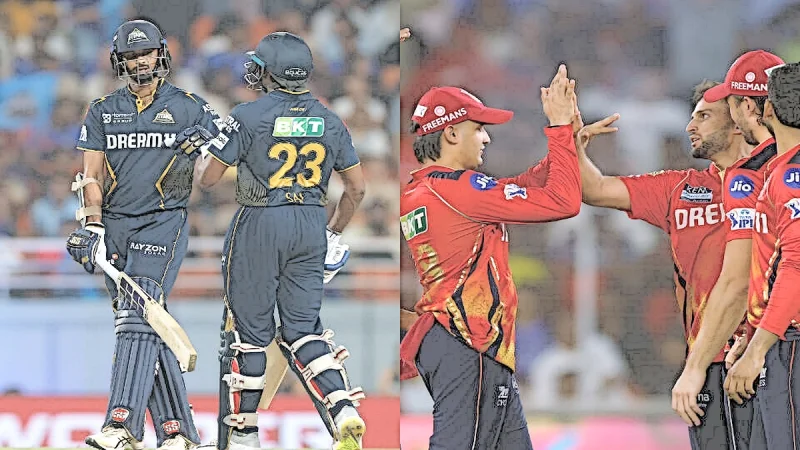
On paper, the clash between Gujarat Titans and Punjab Kings at Mullanpur will be remembered as a close contest — a three-wicket win, a last-over finish, a dramatic collapse, and a debutant stealing the spotlight.
But if you watched closely — not as a fan, but as someone who understands how T20 cricket really works — the truth becomes uncomfortable:
Gujarat Titans were never truly in control of this game.

Even when Punjab stumbled…
Even when wickets fell…
Even when Prasidh Krishna suddenly turned the game on its head…
The foundation required to win had already been lost.
This wasn’t a last-over defeat.
This was a structural defeat disguised as a thriller.
Match Overview: A Competitive Score That Was Never Really Enough
- Gujarat Titans: 162/6 (20 overs)
- Punjab Kings: 165/7 (19.1 overs)
On paper, 162 appears competitive.
In reality, on this surface and with the way the game unfolded, it was a total that always required near-perfect execution with the ball.
Gujarat never provided that.
Mullanpur Conditions: A Surface That Rewarded Intelligence, Not Force
The pitch at Mullanpur wasn’t flat, nor was it excessively difficult. It sat somewhere in between — offering enough grip for bowlers while still allowing batters to score if they adapted early.
This kind of surface demands:
- Strike rotation over blind hitting
- Variation in pace from bowlers
- Tactical awareness from captains
Punjab Kings understood this almost immediately.
Gujarat Titans did not.
And that difference in reading conditions defined the match.
Read Related News
Aditya Birla–Times of India Consortium Acquires RCB for $1.78 Billion
Abhishek Sharma’s Rise: The Fearless Star Changing India’s T20 Game
BCCI Broadcast Engineer Found Dead
RR vs CSK Post Match Analysis
Gujarat Titans’ Batting: A Structurally Flawed Innings
At 54/1 in the powerplay, Gujarat were well-positioned. With Shubman Gill and Jos Buttler at the crease, the expectation was clear: build a platform and accelerate toward 180.
That acceleration never came.
The Dot Ball Problem
The most damaging statistic from Gujarat’s innings was not wickets — it was dot balls.
A dot-ball percentage of approximately 37.5% meant:
- Nearly 8 overs produced no runs
- Pressure built steadily without release
- Batters were forced into high-risk strokes later
In modern T20 cricket, this is unsustainable. Teams can recover from early wickets; they rarely recover from prolonged stagnation.
Jos Buttler’s Slow Burn
Buttler’s innings (38 off 33) reflected a deeper issue. While he occupied the crease, he did not impose himself on the bowling.
- Strike rate around 115
- Limited boundary frequency
- Minimal pressure on opposition bowlers
On a pitch where timing was difficult, such an innings required either strong support or late acceleration. Gujarat had neither.
Momentum Disruption: Wickets at the Worst Possible Time
Another critical flaw was the timing of dismissals.
Every time Gujarat seemed ready to shift gears, they lost a set batter.
- Gill dismissed just as acceleration phase approached
- Buttler fell before the death overs
- Middle order forced into immediate aggression
This disrupted innings continuity and ensured that no batter carried momentum into the final overs.
The result:
Only 34 runs scored in the last five overs.
That phase alone cost Gujarat at least 15–20 runs — the exact margin that defined the match.
Shreyas Iyer’s Captaincy: Control Without Noise
If Gujarat’s innings reflected hesitation, Punjab’s approach reflected clarity.
Shreyas Iyer did not rely on dramatic decisions. Instead, he demonstrated something far more valuable: situational awareness.
Key Captaincy Decisions
- Introduced spin early when pitch showed grip
- Encouraged bowlers to use cutters and slower deliveries
- Focused on restricting runs rather than chasing wickets
This approach ensured Gujarat never built sustained momentum.
Notably, the use of Yuzvendra Chahal in the middle overs proved decisive, breaking partnerships precisely when Gujarat needed stability.
Punjab Kings’ Chase: Structured, Not Spectacular
Chasing 163, Punjab Kings approached the innings with clarity.
They did not attempt to dominate immediately.
They aimed to control the required rate.
Powerplay Advantage
Punjab’s early scoring ensured:
- Required rate remained manageable
- Scoreboard pressure never escalated
- Gujarat’s bowlers were forced onto the defensive
This phase, often overlooked, was arguably the most decisive segment of the match.
The Collapse That Didn’t Matter
From 110/2 to 118/6, Punjab briefly lost control.
On most days, such a collapse results in defeat.
But here’s the key difference:
The required rate was still under control.
Because of the strong start, Punjab had a buffer.
That buffer allowed them to absorb the collapse without panic.
The Prasidh Krishna Decision: A Tactical Error That Defined the Match
The most discussed — and most critical — decision of the match involved Prasidh Krishna.
The Issue
Prasidh Krishna, Gujarat’s leading strike bowler, was introduced only in the 12th over.
By that time:
- Punjab had crossed 100
- Required rate was comfortable
- Batters were set
Immediate Impact
Once introduced, Prasidh:
- Took 3 quick wickets
- Triggered Punjab’s collapse
- Briefly revived Gujarat’s chances
The Underlying Problem
His success only highlighted the error.
Had he bowled earlier — particularly in the powerplay — he could have:
- Broken early partnerships
- Increased required rate
- Created sustained pressure
Instead, Gujarat allowed Punjab to settle before attacking.
In T20 cricket, that sequence rarely works.
The Real Turning Point: Powerplay Control
While the late wickets created drama, the true turning point occurred much earlier.
Punjab’s powerplay score ensured:
- The chase remained within control
- Pressure never escalated
- Even a collapse could be managed
This phase effectively neutralized Gujarat’s late comeback.
Cooper Connolly: Composure Beyond Experience
The standout performance came from debutant Cooper Connolly.
His innings was not defined by aggression, but by decision-making.
- Rotated strike effectively
- Chose the right moments to attack
- Maintained composure during collapse
Notably, his ability to handle Rashid Khan under pressure indicated a level of maturity uncommon for a debutant.
This was not a flashy innings.
It was a match-winning innings built on awareness.
What Gujarat Titans Got Wrong — A Summary
1. Excessive Dot Balls
Failure to rotate strike created pressure that led to poor shot selection.
2. Lack of Middle-Over Acceleration
No batter transitioned from anchor to aggressor.
3. Poor Timing of Wickets
Set batters failed to carry innings into final overs.
4. Delayed Use of Strike Bowler
Prasidh Krishna’s late introduction reduced his overall impact.
5. Ineffective Powerplay Bowling
Punjab were allowed to score freely early in the chase.
What Punjab Kings Got Right
1. Better Reading of Conditions
Adapted quickly to pitch behavior.
2. Structured Chase
Maintained control over required rate throughout.
3. Smart Bowling Rotations
Used variations effectively to disrupt rhythm.
4. Composure Under Pressure
Handled collapse without panic.
5. Leadership Clarity
Shreyas Iyer ensured consistency in decision-making.
The Psychological Difference Between the Two Teams
Punjab Kings
- Looked in control
- Played with clarity
- Responded to situations
Gujarat Titans
- Looked uncertain
- Reacted late
- Missed key moments
This difference is not visible in scorecards.
But it decides matches.
Individual Brilliance and Iconic Moments
Beyond the tactical battles and captaincy decisions, this match was ultimately brought to life by moments of individual brilliance — the kind that don’t just influence results, but stay with fans long after the final ball is bowled.
At Mullanpur, it wasn’t just about strategies unfolding; it was about players stepping into the moment, producing flashes of skill, courage, and instinct that shifted momentum in real time.
“Air Bartlett”: A Catch That Changed the Rhythm
In a game where Gujarat Titans were searching for late momentum, Jos Buttler looked set to provide it. Having worked his way to 38, he began to open up, sensing an opportunity to accelerate.
Yuzvendra Chahal floated one up, tempting the big shot. Buttler advanced and connected cleanly, aiming to clear long-on — a shot that, nine times out of ten, sails into the crowd.
But this was the tenth time.
Xavier Bartlett, positioned near the boundary, judged the trajectory early. What followed was not just athleticism, but timing of the highest order — a perfectly executed leap, arms stretched to their limit, and a clean take above his head.
For a brief moment, the stadium paused.
Then came the roar.
This dismissal did more than remove a batter. It halted Gujarat’s only realistic chance of a late surge and ensured their innings finished below potential. It was a reminder that in T20 cricket, a single fielding effort can be as decisive as a fifty.
The 103-Meter Statement: Connolly Announces Himself
Every season introduces a new name, but very few arrive with authority.
Cooper Connolly did.
In the 8th over of the chase, with Punjab Kings already in control, Connolly produced a moment that shifted not just the scoreboard, but the psychological balance of the game.
Standing firm, he picked his length early and struck through the line — a clean, commanding shot that traveled 103 meters straight down the ground.
There was no scramble, no mis-hit, no luck involved.
Just timing, balance, and intent.
That single strike sent a clear message:
Punjab were not chasing cautiously — they were dictating terms.
By that stage, Punjab had already begun to dominate the boundary count, eventually registering seven sixes in the first eight overs compared to Gujarat’s three across their entire innings. Connolly’s shot wasn’t just about distance; it symbolized the difference in approach between the two sides.
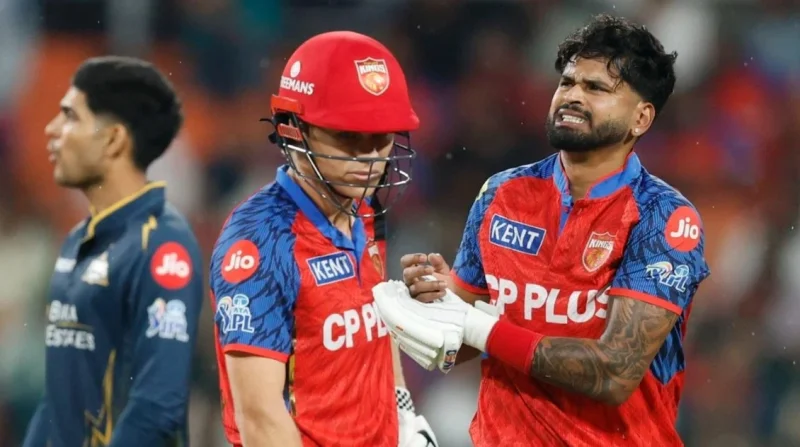
A Moment of Silence: Shreyas Iyer’s Injury Scare
Amid the flow of the game, one moment shifted attention away from cricket entirely.
In the 12th over, a firm straight drive from Cooper Connolly struck Shreyas Iyer at the non-striker’s end, catching him flush on the wrist.
The reaction was immediate.
Iyer went down in visible discomfort, and the atmosphere in the stadium changed instantly. The noise faded. Concern replaced excitement.
Medical staff rushed in as teammates gathered around, and for a brief period, the match felt secondary.
What followed, however, spoke volumes about Iyer’s character. After receiving treatment and strapping, he chose to continue, despite the evident pain.
But cricket often offers little time for recovery.
On the very next delivery he faced, he was dismissed by Prasidh Krishna.
Whether the injury played a role or not is difficult to quantify, but the sequence added a human dimension to the contest — a reminder that behind tactical analysis and performance metrics are players dealing with real physical impact under pressure.
A Game Decided by Awareness, Not Drama
This match will be remembered as a close finish.
But the reality is simpler:
Punjab Kings won because they understood the game better.
Gujarat Titans lost because they reacted too late.
In modern T20 cricket, matches are rarely lost in the final over.
They are lost in the quiet overs — where momentum is either built or wasted.
At Mullanpur, Punjab built it.
Gujarat wasted it.
And that made all the difference.
About the Author

Sudhanshu Shekhar Sudhanshu Shekhar is a cricket analyst and sports writer specializing in IPL, international cricket, and tournament analysis. As the Sports Editor of ApexAdPros, he provides in-depth match breakdowns, player insights, and cricket statistics for fans around the world. His coverage focuses on match strategies, key moments, and emerging cricket talent across global tournaments.
View all posts →