Pakistan’s Two-Day Festival Ends in Three Hours
For two days, Pakistan’s cricket ecosystem behaved like Diwali arrived early.
The reason? India lost a match to South Africa in the T20 World Cup 2026.
YouTube thumbnails were screaming. Panels were debating India’s “downfall.” Social media experts declared the “end of dominance.” If happiness had a stock market, it hit upper circuit.
But cricket has a strange habit.
It checks your excitement before it checks your opponent.
And then came England.
The Toss Decision That Aged Like Warm Milk
In the high-stakes Super 8 clash of Pakistan vs England, Pakistan won the toss and chose to bat first.
The logic sounded solid:
“No team has chased successfully in Super 8 yet.”
However, this is international cricket—not mohalla logic where one previous match sets permanent rules.
Pakistan posted 165. Respectable? Yes.
Match-winning? Only if the bowling unit turned into 1992 nostalgia mode.
Farhan’s Effort and the Familiar Storyline
Sahibzada Farhan once again stood tall. Another half-century. Another rescue job.
At this point, he isn’t part of the batting lineup.
He is the entire department.
Fakhar Zaman and Shadab Khan added useful runs, pushing the total to a competitive mark. On that surface, 165 felt defendable.
But defending totals requires consistency, not just motivation speeches.
Shaheen Afridi’s Fireworks — Then Silence
First ball of England’s chase.
Shaheen Afridi removed Phil Salt.
Stadium noise increased. Social media revived. Optimism returned.
At 25/3, England looked shaky.
If this were a Bollywood film, interval ho chuka hota and Pakistan fans would already be planning celebration reels.
But real cricket doesn’t follow interval scripts.
Harry Brook Turns the Script into a One-Sided Lecture
England captain Harry Brook walked in at No. 3.
What followed wasn’t an innings.
It was a practical demonstration.
He attacked spin. He attacked pace. He attacked length.
Every bowler was treated equally—no discrimination.
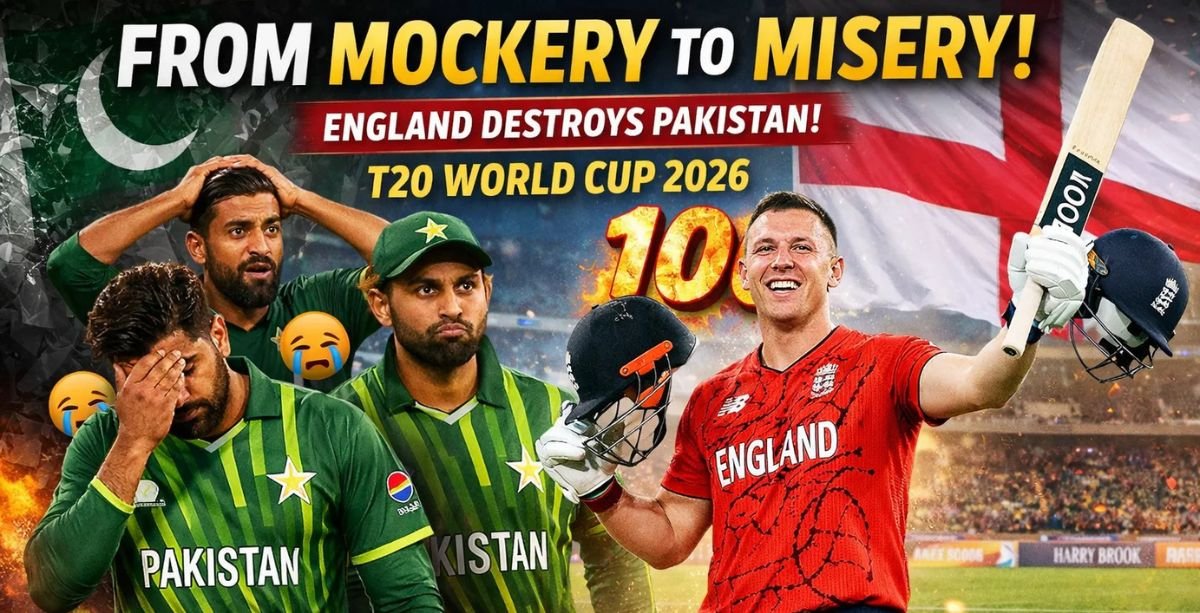
Brook registered a historic century, becoming the first captain in T20 World Cup history to score a hundred.
Pakistan’s bowling went from aggressive to confused in the time it takes to forward a WhatsApp message.
Field placements changed. Plans changed. Expressions changed.
Only the result didn’t.
From “India Finished” to “Calculator Open Karo”
Here lies the irony.
Just 48 hours earlier, the discussion was about India’s dependency on South Africa.
Now Pakistan’s qualification hopes are floating between:
-
Net Run Rate mathematics
-
Other teams’ results
-
And possibly astrology
The same experts who were celebrating India’s loss are now explaining scenarios with whiteboards.
Cricket doesn’t just test technique.
It tests timing of celebration.
The Bigger Picture in the Super 8 Stage
With England sealing their semi-final spot, the group now tightens around New Zealand, Sri Lanka, and Pakistan.
Meanwhile, India also waits on South Africa vs West Indies to simplify qualification.
The T20 World Cup 2026 has officially entered its “spreadsheet phase.”
Analysis: What Went Wrong for Pakistan?
-
Overdependence on one batter.
-
Lack of bowling control in middle overs.
-
Inability to close pressure moments.
-
Emotional overconfidence after external results.
Celebrating a rival’s defeat is part of fan culture.
But cricket has a simple rule:
Win your own match first.
Conclusion: Cricket’s Favourite Plot Twist
Pakistan’s joy ride lasted two days.
England needed three hours to reverse it.
Harry Brook didn’t just score runs—he reset the narrative.
In tournament cricket, mockery travels fast.
But so does karma.
Who scored a century in Pakistan vs England T20 World Cup 2026 match?
Harry Brook scored a historic century as England captain.
Is Pakistan eliminated from T20 World Cup 2026?
Pakistan’s qualification depends on remaining Super 8 results and net run rate scenarios.
Why was this match important?
It confirmed England’s semi-final berth and significantly hurt Pakistan’s campaign.
Cricket fans can celebrate.
They can mock.
They can debate.
But in tournaments like the T20 World Cup 2026, one bad evening can silence two loud days.
And that’s exactly what happened.