KKR’s IPL 2026 Crisis: Inside the Injuries, Exits, and High-Stakes Gamble Before the First Ball
Introduction: A Champion Under Pressure
Winning a title in the IPL is never easy—but for Kolkata Knight Riders (KKR), the 2026 season hasn’t even begun, and the pressure is already mounting.
What should have been a confident title defense has instead turned into a test of resilience. Injuries, geopolitical complications, and squad reshuffles have disrupted the team’s balance at a critical moment. The “Purple Heart,” known for its aggressive bowling attack and tactical sharpness, suddenly looks vulnerable.
From losing their most promising Indian pacer to navigating external political pressures and betting big on uncertain replacements, KKR’s campaign is being shaped as much off the field as on it.
This is not just a squad update—it’s a full-blown crisis that could define their season.
Section I: The Harshit Rana Void — A Blow That Cuts Deep
The biggest and most immediate concern for KKR is the absence of Harshit Rana.
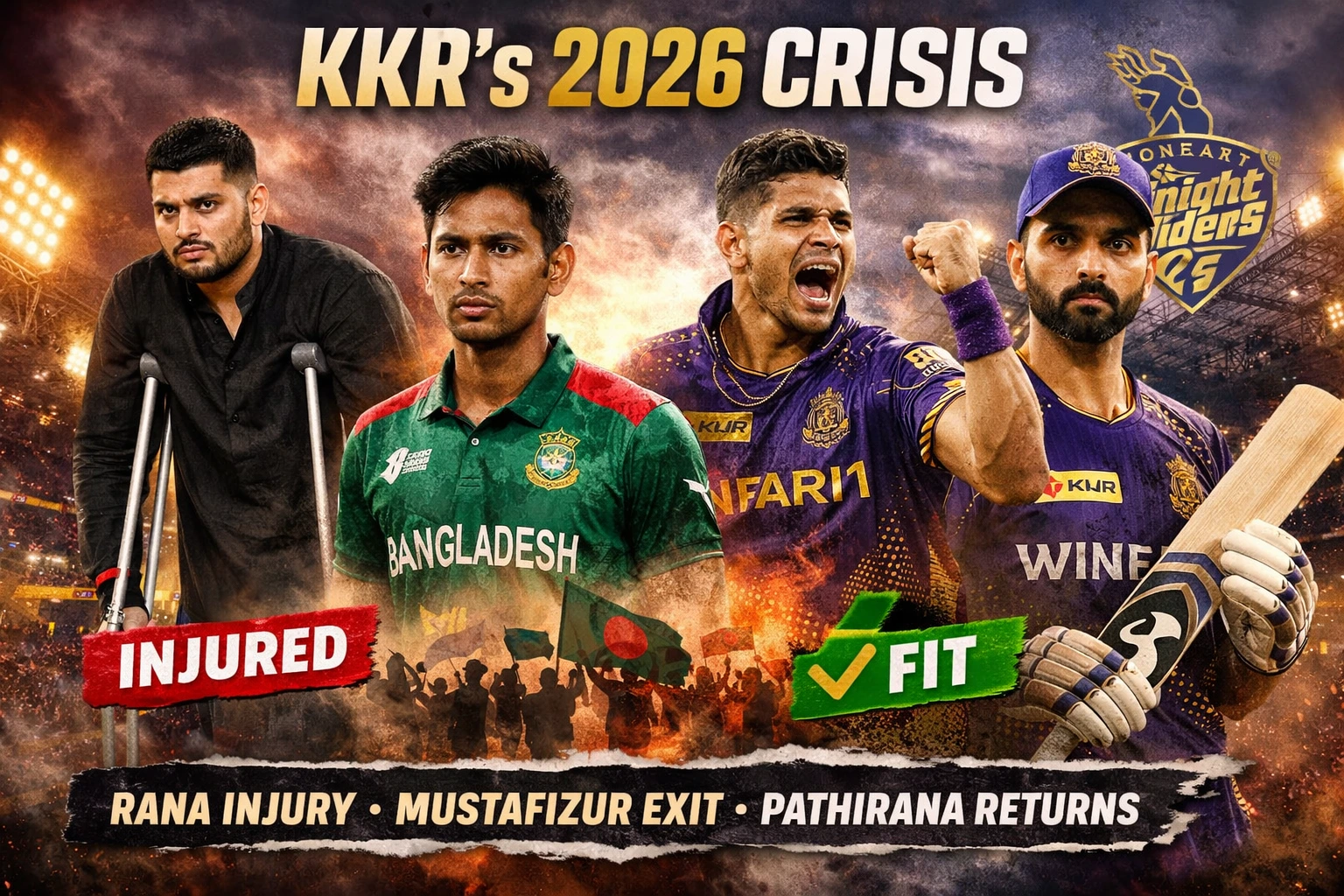
The young pacer, who had quickly become a cornerstone of KKR’s bowling attack, has been ruled out of the entire IPL 2026 season. The reason is serious: a ligament tear in his knee, sustained during a T20 World Cup warm-up match.
He underwent surgery on February 9, 2026, in Mumbai—a procedure that effectively ended his chances of participating in this year’s IPL.
But beyond the medical reports, the most telling moment came on March 15 at the BCCI Naman Awards. Rana appeared on crutches, visibly struggling to move. He couldn’t even walk up to the podium to receive his award, forcing IPL Chairman Arun Dhumal to step down and hand it to him.
That image said everything. This wasn’t a minor injury—it was a long-term setback.
Why His Absence Hurts More Than Expected
Rana wasn’t just another pacer in the squad. He represented something rare: a dependable Indian fast bowler who could deliver in pressure situations.
In the IPL ecosystem, quality Indian pacers are gold. Overseas slots can be filled, but domestic talent—especially one with pace, control, and temperament—is irreplaceable mid-season.
KKR’s current backups—Vaibhav Arora and Akash Deep—have talent, but consistency remains a concern. Neither has yet proven the ability to lead an attack across an entire tournament.
The Tactical Gap
Rana’s absence creates multiple issues:
-
Lack of a reliable new-ball option
-
Reduced death-over control
-
Increased pressure on overseas bowlers
-
Overexposure of inexperienced domestic players
This isn’t just a missing player—it’s a structural weakness in the bowling unit.
Section II: The Mustafizur Rahman Exit — When Cricket Meets Geopolitics
If injuries weren’t enough, KKR also had to deal with an unexpected off-field disruption: the release of Mustafizur Rahman.
The Bangladeshi pacer had been secured for ₹9.20 crore during the mega auction—a significant investment that indicated KKR’s trust in his experience and skill.
But in January 2026, everything changed.
The Forced Decision
Following a directive from the BCCI, KKR was compelled to release Mustafizur. The decision was linked to escalating political instability and humanitarian concerns in Bangladesh, which triggered strong reactions from fan groups.
The situation quickly moved beyond cricket. Public sentiment, protests, and broader geopolitical tensions created an environment where continuing with Bangladeshi players became controversial.
KKR, like other franchises, had little choice but to comply.
The Cost Beyond Money
The ₹9.20 crore investment instantly became a sunk cost—but the real damage was strategic.
Mustafizur brings something very few bowlers can replicate:
-
Exceptional slower balls
-
Experience in Indian conditions
-
Proven IPL performance under pressure
Losing him so close to the season meant KKR had to rebuild their bowling strategy from scratch.
A Disruption in Planning
Teams spend months planning combinations, roles, and matchups. Removing a key overseas bowler disrupts:
-
Bowling rotations
-
Match-specific strategies
-
Balance between pace and variation
This wasn’t just a replacement issue—it forced a rethink of the entire bowling unit.
Section III: The Muzarabani Gamble — A High-Risk Replacement
To fill the void left by Mustafizur Rahman, KKR turned to Zimbabwean pacer Blessing Muzarabani.
On paper, it looks like a bold and exciting move.
Muzarabani arrives with momentum, having taken 13 wickets in the recent T20 World Cup. His height, bounce, and ability to generate awkward angles make him a unique threat.
But IPL pressure is a different beast.
Strengths He Brings
-
Extra bounce due to height
-
Ability to trouble batters on good-length deliveries
-
Strong recent international form
These attributes could make him effective, especially on pitches offering assistance.
The Big Question: Can He Handle Eden Gardens?
Eden Gardens is not just another venue. It’s a high-pressure environment where expectations are intense and margins are small.
Muzarabani faces several challenges:
-
Adjusting to flat Indian pitches
-
Handling aggressive IPL batting lineups
-
Delivering under constant scrutiny
Unlike Mustafizur, who has years of IPL experience, Muzarabani will be learning on the job.
Risk vs Reward
This move is a classic IPL gamble.
If it works, KKR could discover a match-winner.
If it doesn’t, the bowling attack could struggle throughout the season.
There is very little middle ground.
Section IV: The Pathirana Factor — KKR’s Biggest Hope
Amid all the uncertainty, one name offers hope: Matheesha Pathirana.
KKR invested heavily in the Sri Lankan pacer, spending ₹18 crore to secure his services. Known for his slingy action and deadly yorkers, Pathirana is one of the most exciting T20 bowlers in the world.
But even his availability was in doubt.
The Injury Scare
Pathirana missed the latter half of the T20 World Cup due to a calf injury. Naturally, this raised concerns about whether he would be fit in time for IPL 2026.
For a team already dealing with bowling issues, losing him would have been disastrous.
The Green Light
As of March 16, 2026, KKR’s medical team has cleared him completely.
He has:
-
Joined the training camp in Kolkata
-
Regained full fitness
-
Been confirmed for the opening match against Mumbai Indians on March 29
This update changes everything.
Why He Is Now the Most Important Player
With Harshit Rana out and Mustafizur gone, Pathirana becomes the centerpiece of KKR’s bowling attack.
His role will include:
-
Leading the pace unit
-
Handling death overs
-
Delivering breakthroughs in key moments
If Pathirana performs at his peak, KKR can still remain competitive. If he struggles, the bowling unit could collapse.
He is no longer just a key player—he is the system around which everything revolves.
Section V: Rahane’s Defensive Captaincy — Managing a Fragile Unit
In the middle of all this uncertainty stands Ajinkya Rahane, the captain for IPL 2026.
Known for his calm demeanor and classical approach, Rahane is not an aggressive, high-risk leader. Instead, he relies on structure, discipline, and calculated decisions.
This season, that approach will be tested like never before.
The Challenge Ahead
Rahane inherits a bowling unit that is:
-
Short on experience (domestic players)
-
Dependent on one or two key performers
-
Lacking depth due to injuries and exits
His primary task will be to protect this unit.
Tactical Adjustments He Must Make
-
Smart Powerplay Management
Without a strong new-ball specialist, Rahane must rotate bowlers carefully to avoid early damage. -
Flexible Bowling Changes
He may need to use part-time options or unconventional matchups. -
Maximizing Pathirana’s Overs
Using him at the right moments—not just at the death—could be crucial. -
Field Placements Over Aggression
Expect defensive fields early, focusing on damage control rather than outright domination.
Leadership Style Matters
Rahane’s strength lies in stability. In a chaotic situation, that calmness can help the team stay composed.
But the IPL is unforgiving. Sometimes, bold decisions win matches—and Rahane will need to balance caution with calculated risks.
Conclusion: A Season Defined by Survival, Not Dominance
KKR’s IPL 2026 campaign is shaping up to be less about winning a title and more about surviving adversity.
The loss of Harshit Rana has weakened the core.
The exit of Mustafizur Rahman has disrupted planning.
The arrival of Muzarabani introduces uncertainty.
The fitness of Pathirana offers hope—but also pressure.
And Rahane’s leadership will be the glue holding it all together.
This is no longer a perfect squad chasing dominance.
This is a team adapting, adjusting, and fighting to stay relevant.
In many ways, this crisis could define KKR’s identity for the season. If they overcome it, the story becomes one of resilience. If they don’t, it will serve as a reminder of how quickly fortunes can change in the IPL.
One thing is certain—when KKR steps onto the field on March 29, they won’t just be playing a match.
They’ll be trying to prove that even under pressure, a champion still knows how to fight.
About the Author

Sudhanshu Shekhar
Sudhanshu Shekhar is a cricket analyst and sports writer specializing in IPL, international cricket, and tournament analysis. As the Sports Editor of ApexAdPros, he provides in-depth match breakdowns, player insights, and cricket statistics for fans around the world. His coverage focuses on match strategies, key moments, and emerging cricket talent across global tournaments.