

Pakistan’s Super 8 Qualification Hopes Hit After New Zealand vs Sri Lanka Thriller
There’s an old saying — you should never celebrate someone else’s misfortune.
To simplify it: imagine running a race, finishing behind, yet feeling satisfied simply because your neighbor didn’t win. That kind of satisfaction may offer temporary comfort, but it does not change your own result.
In cricket, especially during global tournaments, this mindset often surfaces. Over the past few days, events in the Super 8 stage have demonstrated exactly why focusing on others’ defeats rarely works as a long-term strategy.
Short-Lived Celebrations
Just 36 hours before Pakistan’s crucial scenario unfolded, there was visible excitement among Pakistani fans after India’s loss to South Africa. Social media reactions were intense, as if momentum had shifted dramatically. And most importantly this loss of India was not going to help or impact Pakistan postion as they both are in different group.

However, tournament cricket moves fast.
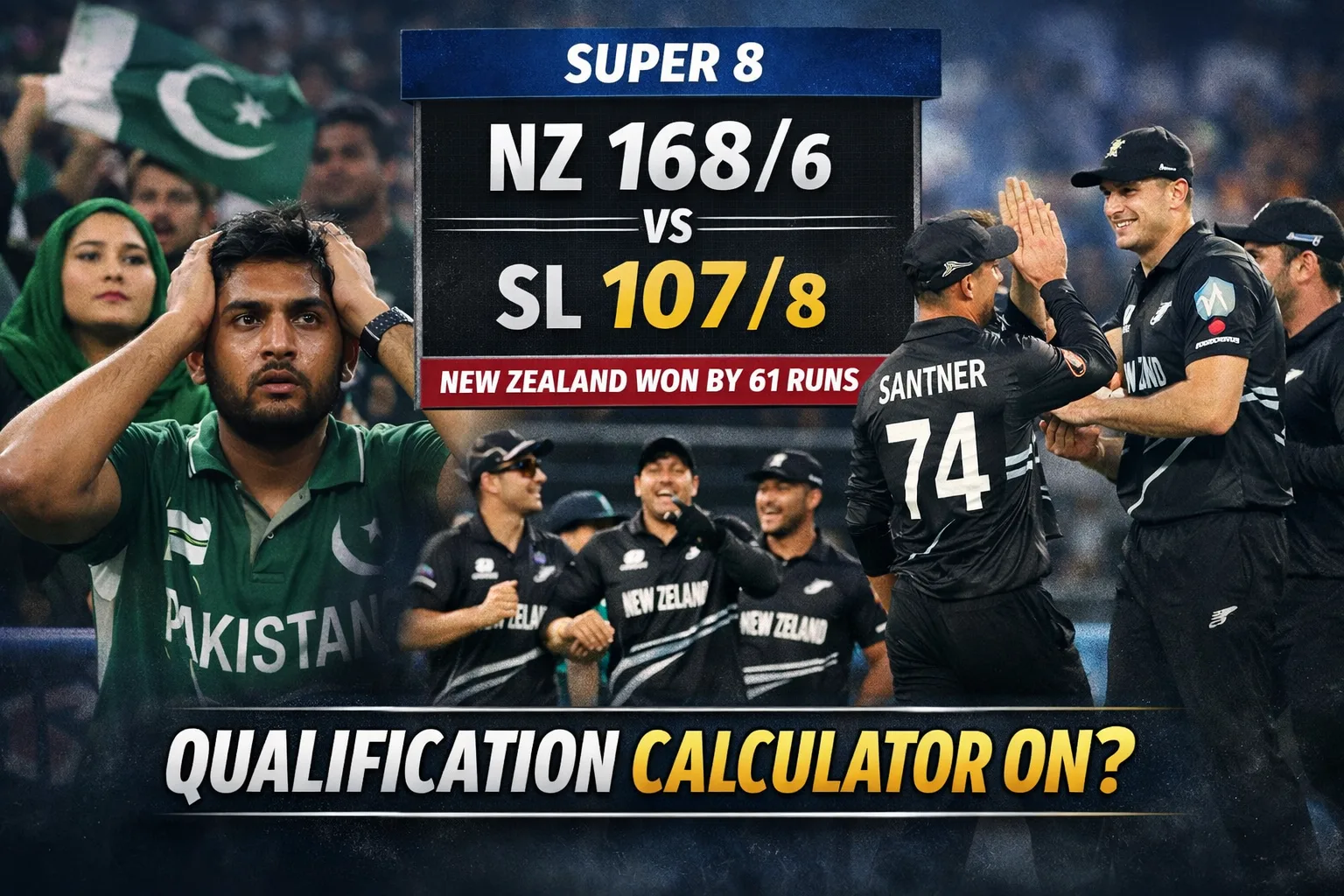
Within 48 hours, Pakistan suffered a defeat of their own. And in another 24 hours, the team relying upon — Sri Lanka — was comprehensively beaten by New Zealand, further complicating Pakistan’s qualification pathway.
This is the unpredictable nature of tournament cricket: fortunes change rapidly, and dependency on external results is rarely sustainable.
The New Zealand vs Sri Lanka Turning Point
The Super 8 encounter between New Zealand and Sri Lanka was technically just another fixture. But strategically, it held significant importance for Pakistan.
For the first 15 overs of New Zealand’s innings, Sri Lanka appeared in control. At 84 for 6, the match looked balanced. At that stage, even a total around 120–130 seemed manageable.
Then came a decisive shift.
Mitchell Santner and the New Zealand lower order mounted an aggressive counterattack. The momentum swung dramatically as New Zealand surged to 168, adding nearly 70 runs in the final four overs. That late acceleration proved decisive — not only for Sri Lanka but also for Pakistan’s hopes.
Sri Lanka’s chase never gained traction. Early wickets derailed the innings, and they eventually fell well short, finishing at 107 for 8 and losing by 61 runs. The Net Run Rate implications further complicated matters for Pakistan.
The Qualification Equation
Technically, Pakistan still remain in contention — but the pathway is narrow:
Pakistan must defeat Sri Lanka convincingly.
New Zealand would need to suffer a heavy loss against England.
Both scenarios require precise outcomes — and reliance on multiple variables beyond Pakistan’s direct control.
A Broader Perspective
Since their historic 1992 World Cup victory, Pakistan’s cricket journey has often been described as dramatic and unpredictable. Their highs have been exceptional; their lows equally striking.
In the modern era of live broadcasts and constant digital scrutiny, every performance is analyzed instantly. There are no narratives that can remain hidden. Results speak clearly and immediately.
The central lesson here is simple: qualification cannot depend on hope, external results, or celebratory reactions to other teams’ defeats. Tournament success demands preparation, execution, and consistency.
In professional sport, performance — not prayers or projections — determines progress.
Final Thought
Cricket is ultimately straightforward:
Play well. Prepare thoroughly. Deliver under pressure.
Qualification is not something granted upon request. It is earned on the field.
And in tournaments of this magnitude, there are no shortcuts.
About the Author

Prithu Bhargava Sports writer covering IPL and Test cricket.
View all posts →