

The Dark Conspiracy Theories That Follow Pakistan Cricket
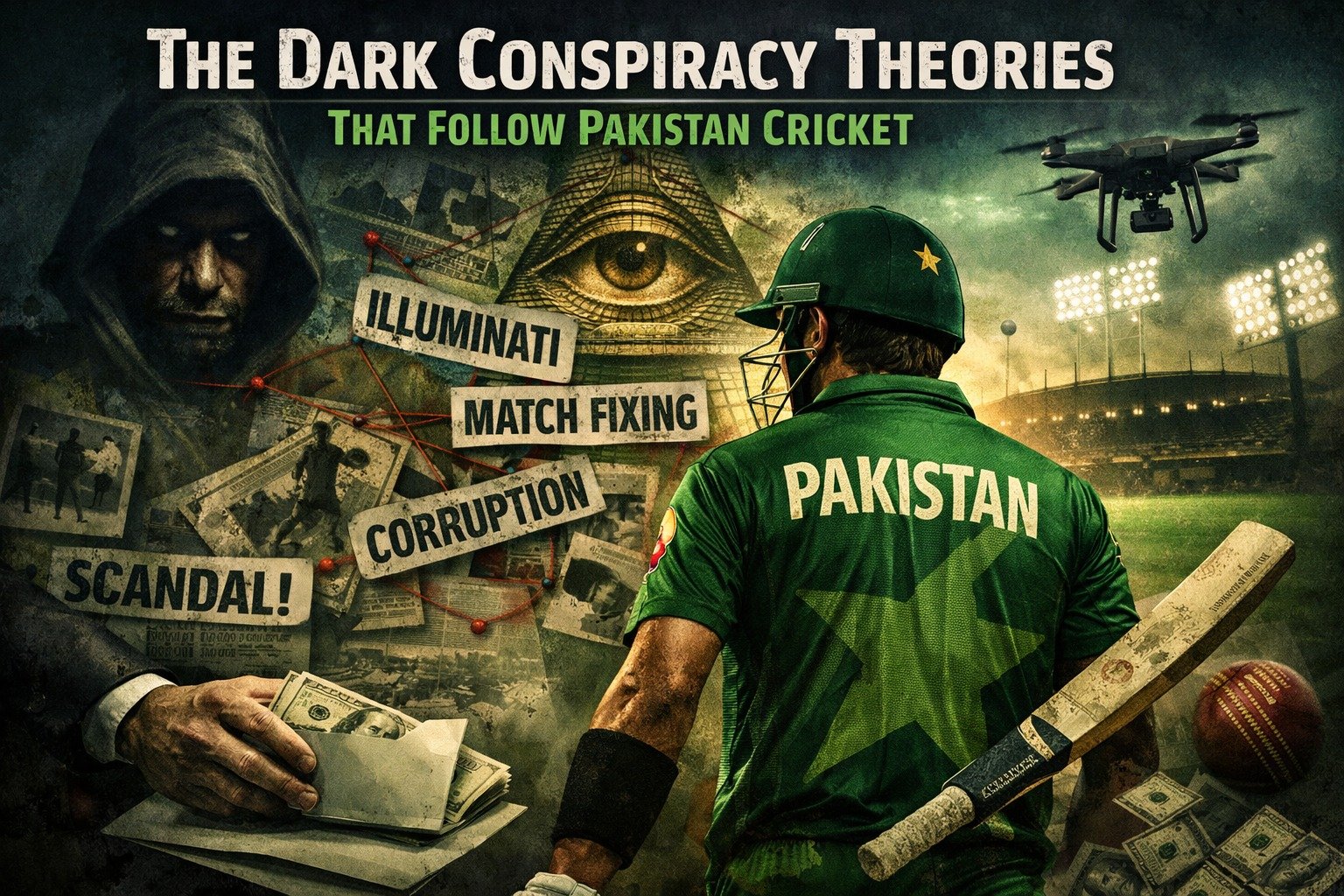
Truth, Myths, and the Unpredictable Legacy of the Green Jersey
I. Introduction: The Enigma of the Green Jersey
Few teams in world cricket evoke as much fascination, debate, and mystery as Pakistan. The nation has produced some of the greatest talents the sport has ever seen. From the lethal swing of Wasim Akram and Waqar Younis to the modern elegance of Babar Azam, Pakistan’s cricketing history is filled with extraordinary brilliance.
Yet the team has always existed within a strange paradox. Pakistan produces generational cricketing talent despite constant chaos surrounding administration, politics, and controversy.
This unpredictability gave birth to what many fans call the "Cornered Tiger" philosophy — the belief that Pakistan performs best when the odds are stacked against them. When criticism is loud and expectations are low, Pakistan cricket often delivers its most dramatic victories.
However, alongside the magic of the green jersey, whispers of conspiracies, scandals, and hidden forces have followed the team for decades.

II. The 1990s: The Birth of the Whispers
The Justice Qayyum Report
The 1990s were a golden era for Pakistan cricket. The team possessed one of the most feared bowling attacks in cricket history, led by Wasim Akram and Waqar Younis.
However, the decade also saw the emergence of serious allegations of match-fixing. These rumors eventually led to the famous Justice Qayyum Report, an official investigation into corruption within Pakistan cricket.
The report revealed troubling details about relationships between players and bookmakers. Although not all allegations led to punishments, the investigation permanently damaged Pakistan cricket's reputation.
For many fans, this was the first moment when suspicion entered the sport.
The Captaincy Wars
Another factor fueling conspiracy theories was the intense internal politics within Pakistan cricket. During the 1990s, the team often appeared divided between regional power groups, especially those linked to Lahore and Karachi.
These rivalries sometimes resulted in captaincy battles that extended beyond the cricket field.
Accusations of corruption occasionally became weapons used in these internal conflicts. In such an environment, rumors spread quickly and often blurred the line between truth and speculation.
III. 2007: The Death that Changed Everything
The Kingston Tragedy
The 2007 Cricket World Cup delivered one of the most shocking moments in cricket history.
Pakistan had just suffered an unexpected defeat against Ireland. The loss itself was surprising, but what happened next shocked the entire sporting world.
Pakistan coach Bob Woolmer was found dead in his hotel room in Kingston, Jamaica.
Initially, investigators suspected murder. The possibility that a high-profile cricket coach had been killed sparked worldwide headlines.
The "Bookie" Narrative
As investigations unfolded, conspiracy theories began to circulate. One widely discussed theory suggested that Woolmer might have been preparing to expose corruption linked to illegal cricket betting networks.
Cricket betting, particularly in South Asia, represents a massive underground industry worth billions of dollars.
However, after months of investigation, authorities concluded that Woolmer died from natural causes. The murder theory was officially dismissed.
Even today, many fans believe the mystery was never fully solved.
IV. 2010: The Fall of the Prodigy
The Lord’s No-Balls
In 2010, Pakistan cricket faced one of its darkest moments.
During a Test match against England at Lord’s, unusual no-balls were bowled at specific moments during the game. A newspaper investigation later revealed that bookmakers had predicted these deliveries in advance.
The scandal exposed a spot-fixing operation involving Pakistani players.
Among them was the young fast bowler Mohammad Amir, who was only eighteen years old at the time.
The incident led to bans and prison sentences, shocking cricket fans around the world.
The Institutional Theory
While the official investigation blamed a small group of players, some observers argued that deeper forces might have been involved.
Illegal betting syndicates had long been rumored to influence cricket matches. Some analysts suggested that young players could be vulnerable to pressure from powerful gambling networks.
Regardless of the theories, the scandal forced cricket authorities to strengthen anti-corruption measures across the sport.
V. Geopolitics and the "Global Conspiracy"
The Isolation Era
In 2009, a terrorist attack targeted the Sri Lankan cricket team bus in Lahore.
The shocking incident forced international teams to stop touring Pakistan for nearly a decade.
Pakistan was forced to play its home matches in the United Arab Emirates, losing the advantage of home crowds and familiar conditions.
Some fans believe Pakistan cricket was unfairly isolated during this period, while others argue that safety concerns justified the decision.
The BCCI-ICC Axis
Another widely discussed theory involves the financial power structure of international cricket.
The cricket boards of India, England, and Australia hold significant influence over global cricket revenue and governance.
Many Pakistani fans believe that this financial dominance has limited Pakistan’s influence within the sport.
Whether or not this theory is accurate, it reflects the deep political and economic complexities within modern cricket.
VI. Conclusion: The Survival of the Unpredictable
The Most Unpredictable Team in Cricket
Despite decades of scandals, controversies, and conspiracy theories, Pakistan cricket continues to captivate fans around the world.
The team remains one of the most unpredictable forces in international sport.
One day they collapse unexpectedly. The next day they defeat the strongest teams in the world.
The Resilience of Pakistani Fans
For Pakistani fans, supporting the national team is often an emotional roller coaster.
It is a relationship defined by hope, heartbreak, and pride.
But perhaps that is the true magic of Pakistan cricket.
Because when the Green Shirts feel cornered, history shows they can rise in ways that no one expects.
About the Author

Monis Ali A passionate content writer with a focus on delivering accurate, engaging, and up-to-date information across trending topics. With a strong interest in news, technology, and digital media, they aim to simplify complex stories for everyday readers.
View all posts →